
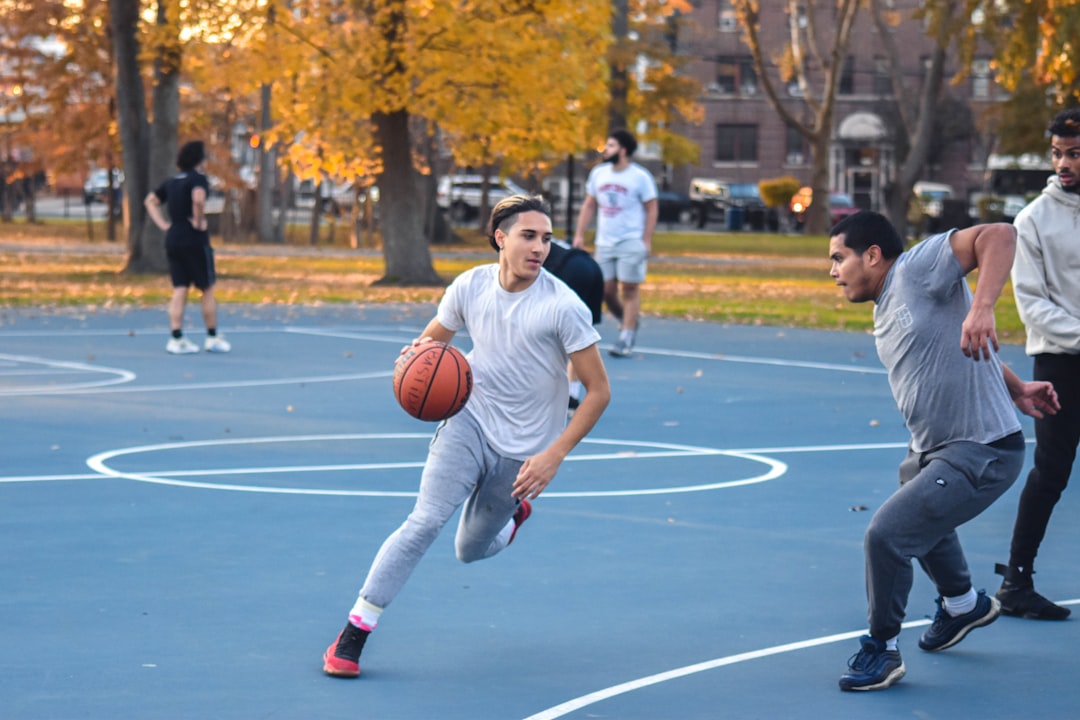
Why Most Basketball Players Are Missing the Most Important Part of Their Training
The best gym exercises for basketball players are not the ones you see bodybuilders doing — they are movements designed to build explosive power, lateral quickness, and the kind of durability that keeps you on the court all season.
Here is a quick look at the most effective gym exercises for basketball players:
| Goal | Top Exercises |
|---|---|
| Vertical jump | Goblet squat, trap bar deadlift, depth jump |
| Lateral quickness | Lateral lunge, lateral bound, Bulgarian split squat |
| Core stability | Plank, medicine ball slam, Pallof press |
| Explosiveness | Medicine ball squat-to-press, resisted glute bridge |
| Injury prevention | Stability ball leg curl, single-leg deadlift, clamshell |
Basketball is a sport of short sprints, sharp cuts, and repeated jumps — not slow, steady effort. That means the gym work has to match. Traditional weightlifting builds mass. Basketball strength training builds athletes.
Yet walk into most school gyms, and you will see young players loading up the bench press or doing bicep curls with no plan behind it. Meanwhile, the movements that actually translate to the court — single-leg strength, rotational power, explosive hip extension — get skipped entirely.
This guide covers everything: the right exercises, the right approach by age and experience level, how to train differently in-season versus off-season, and how to avoid the mistakes that hold most young players back.
I am Kevin O’Shea, a Certified Strength and Conditioning Specialist and wide receiver coach whose background in athletic development directly informs how I approach gym exercises for basketball players at every level. Whether you are a middle schooler just starting out or a high schooler chasing a scholarship, the principles in this guide will give you a clear, actionable path forward.
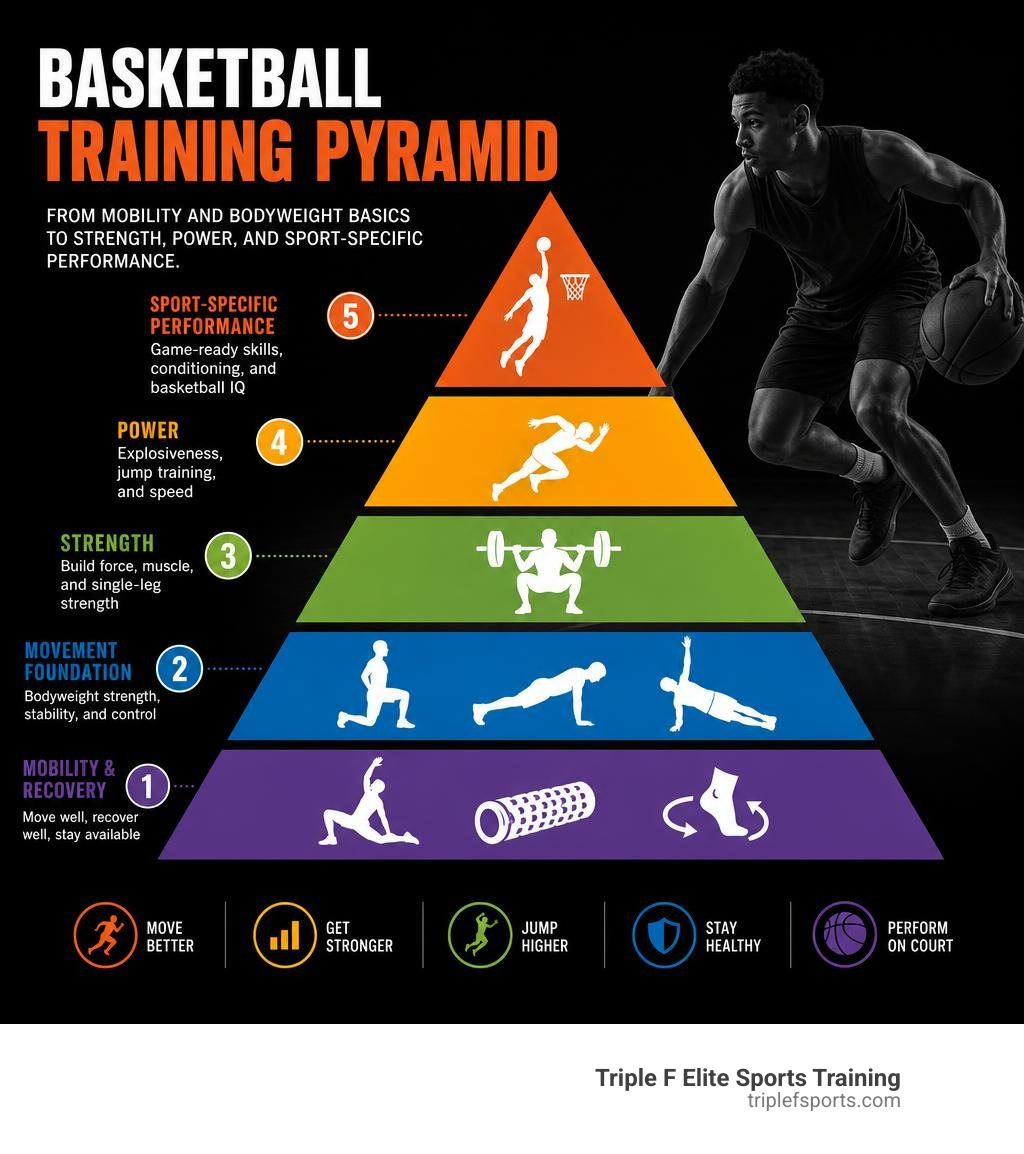
Why Basketball Strength Training Beats Traditional Weightlifting
Many athletes make the mistake of stepping into a commercial gym and copying a standard bodybuilding routine. If your workout split consists of “chest and triceps” on Monday and “back and biceps” on Tuesday, you are training for mirror muscles, not court performance.
Basketball is a multi-directional sport that requires you to accelerate, decelerate, change direction, and jump in a fraction of a second. To do this effectively, your training must focus on athletic attributes rather than pure muscle hypertrophy.

Force Production vs. Force Absorption
Traditional weightlifting only cares about how much weight you can push or pull. In basketball, how you stop is just as important as how you go. Every time you jump for a rebound or execute a hard crossover, your joints absorb massive amounts of force. If your muscles cannot handle this load, your knees and ankles bear the brunt of it, leading to common injuries like patellar tendonitis or ligament sprains.
By training the eccentric (lowering) phase of movements, you teach your nervous system to absorb force safely. This is the foundation of Beyond The Gym Mastering Athletic Strength Training. When you master both force production and force absorption, you build a body that is both explosive and bulletproof.
Functional Strength Over Raw Size
A basketball player needs to remain light, fast, and agile. Adding 20 pounds of non-functional upper-body mass might look good at the pool, but it will slow down your first step and make you tire faster during the fourth quarter.
Instead, we focus on functional strength—training movements, not isolated muscles. This means prioritizing multi-joint compound lifts, unilateral (single-leg) exercises, and core stability. According to How to Strength Train for Basketball, the goal of a basketball-specific program is to optimize your power-to-weight ratio. When you lose non-functional weight while maintaining or increasing your strength, you can experience a double-digit percentage increase in your vertical jump height.
| Feature | Bodybuilding / General Weightlifting | Basketball Strength Training |
|---|---|---|
| Primary Goal | Muscle size (hypertrophy) and symmetry | Explosive power, lateral quickness, durability |
| Movement Planes | Mostly single-plane (sagittal/forward-backward) | Multi-planar (rotational, lateral, vertical) |
| Focus | Isolated muscles (bicep curls, leg extensions) | Integrated movements (compound lifts, single-leg work) |
| Speed of Lift | Slow, controlled repetitions | Controlled eccentric, explosive concentric |
| Injury Prevention | Low emphasis on joint/tendon elasticity | High emphasis on ankle, knee, and hip stability |
Essential Gym Exercises for Basketball Players to Build Power and Agility
To build a truly elite on-court physical profile, your routine must target the specific demands of the sport. We break this down into movements that develop triple extension (the simultaneous straightening of the hips, knees, and ankles), posterior chain strength (glutes and hamstrings), and multi-directional movement.
For a comprehensive, structured approach to pairing these movements, you can reference the BASKETBALL PERFORMANCE WORKOUT: BUILDING A BETTER BALLER routine, which integrates active mobility and explosive lifting splits.
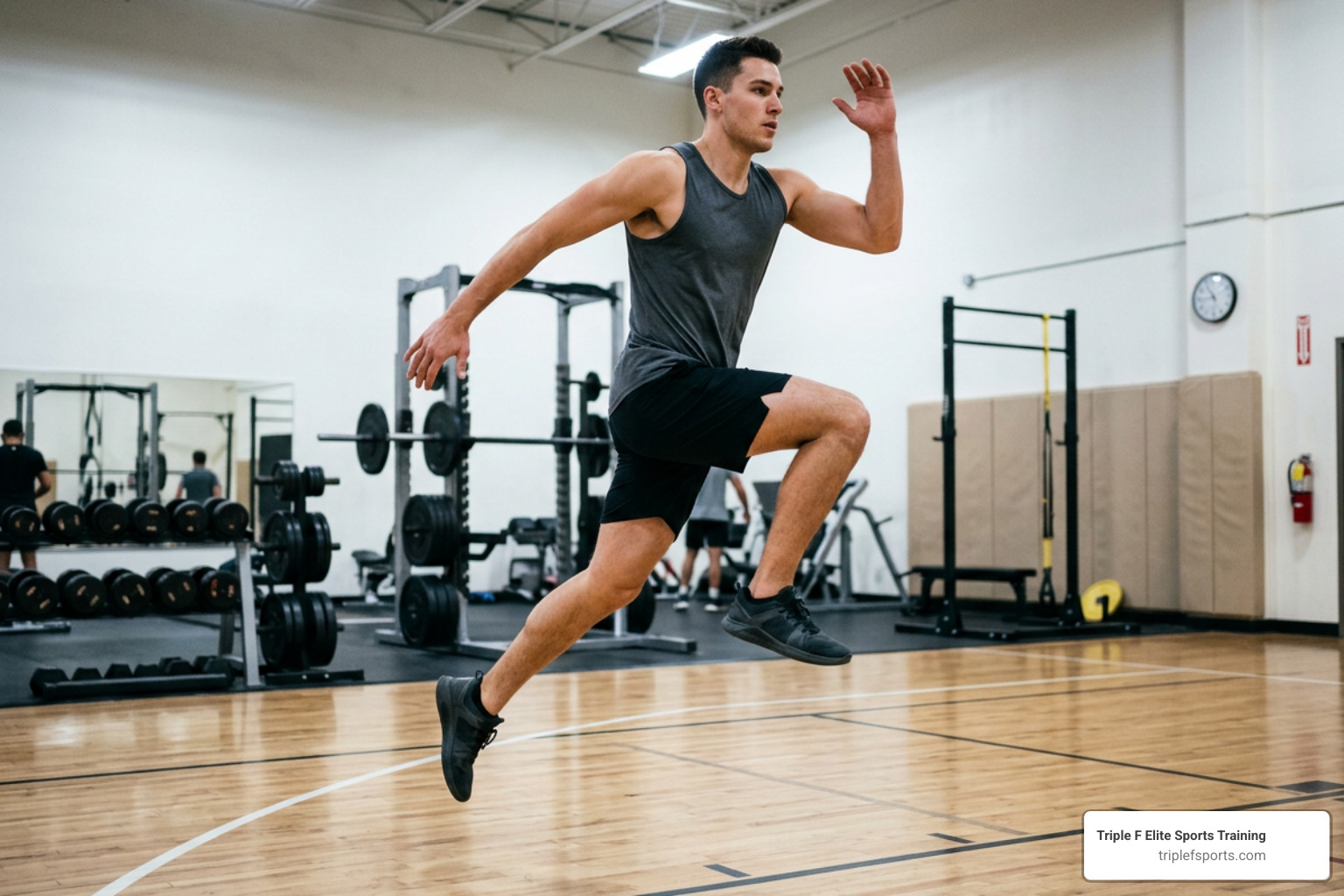
Lower Body Gym Exercises for Basketball Players to Maximize Vertical Jump
If you want to play above the rim, you have to train the muscles responsible for launching you off the hardwood. The glutes and hamstrings are the true powerhouses of your vertical leap. Here are the staple gym exercises for basketball players aiming to maximize their vertical jump:
- Goblet Squats: Perfect for building foundational quad and glute strength while maintaining an upright posture. This exercise teaches proper hip depth and knee tracking, keeping your knees from caving inward (valgus collapse).
- Trap Bar Deadlifts: The trap bar (or hex bar) is an exceptional tool for basketball players. It distributes the load closer to your center of gravity than a traditional barbell, reducing stress on the lower back while allowing you to develop maximum lower-body force.
- Depth Jumps: This plyometric exercise is the ultimate way to train the stretch-shortening cycle (SSC). By stepping off a 16-to-18-inch box and immediately exploding upward upon hitting the ground, you train your nervous system to minimize ground contact time and convert downward force into upward lift.
- Resisted Glute Bridges: Excellent for isolating the glutes without loading the spine, directly translating to horizontal acceleration and vertical power.
When working with younger athletes, we always prioritize movement quality before adding heavy resistance. For a complete look at how to safely progress these movements in youth sports, check out our In Depth Guide To Youth Strength Training.
Unilateral and Lateral Gym Exercises for Basketball Players to Boost Agility
Basketball is rarely played on two feet simultaneously. Whether you are driving for a layup, closing out on a shooter, or sliding defensively, you are constantly pushing off one leg or moving sideways.
- Lateral Bounds (Heiden Jumps): This exercise builds lateral power and teaches force absorption on a single leg. Push off your outside foot, bound sideways as far as possible, and land softly on the opposite foot, holding the landing for a second to demonstrate control. Perform these for 45 seconds per set to build explosive endurance.
- Anterior Loaded Bulgarian Split Squats: By elevating your rear foot on a bench and holding a dumbbell or kettlebell at your chest, you isolate the front leg. This addresses bilateral strength deficits (imbalances between your left and right legs) and builds the single-leg power required for driving layups.
- Weighted Lateral Lunges: Step directly to the side, sinking your hips back while keeping your trailing leg straight. This targets the groin, gluteus medius, and adductors, which are crucial for quick lateral defensive shuffling. Perform 3 sets of 8 to 12 reps on each leg.
To supplement these strength movements with footwork drills, you can explore our breakdown of the Unlock Your Speed Top Agility Ladder Drills For All Levels to keep your feet light and responsive.
Core Stability and Injury Prevention on the Court
A flashy six-pack does not necessarily mean you have a functional core. For a basketball player, the core acts as the bridge that transfers force from your feet up through your hands during a jump shot or pass. If this bridge is weak, you lose power and put unnecessary stress on your lower back.
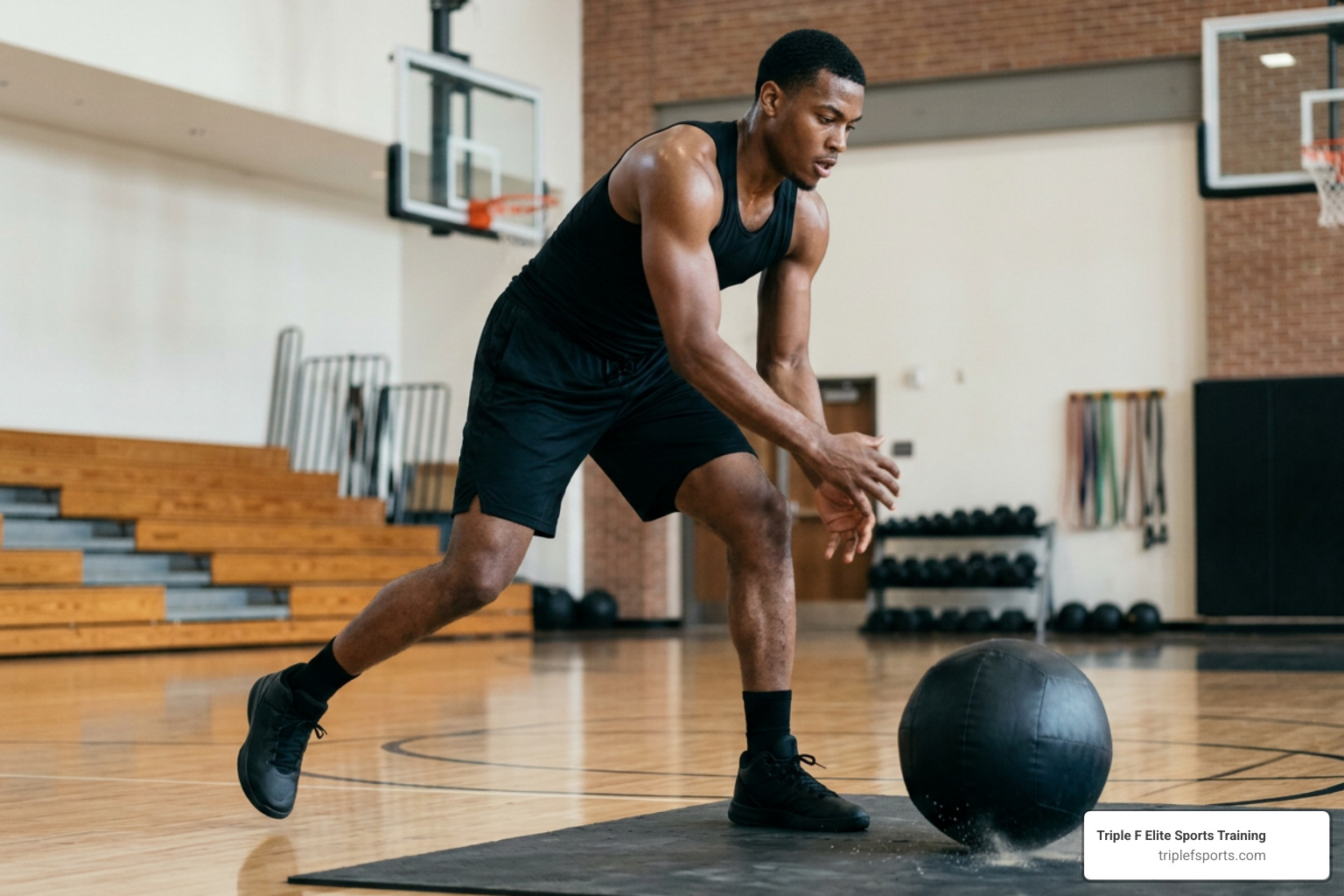
The Transverse Abdominis and Rotational Power
The core encompasses everything from your shoulders to your knees. While the rectus abdominis (the “six-pack” muscle) gets the attention, the transverse abdominis (the deep, internal corset muscle) is what actually stabilizes your spine.
A strong core allows you to absorb contact in the air and still finish a layup. It also provides the rotational power needed to throw crisp passes and pull down strong rebounds. To learn more about how this connection works, read From the Core to the Court: How a Strong Core Enhances Your Basketball Performance.
Bulletproofing Your Joints
Ankle sprains and patellar tendonitis (jumper’s knee) are the most common injuries in basketball. Most of these injuries occur during landing or sudden changes of direction. If your knee tracks inward when you land, or if your ankles lack mobility, you are a ticking time bomb.
By incorporating single-leg deadlifts, stability ball leg curls, and ankle mobilization drills into your routine, you can significantly reduce your injury risk. In fact, a 2022 study published in the Journal of Orthopaedic & Sports Physical Therapy found that a simple 10-minute neuromuscular training warm-up reduced ankle and knee injury rates by 36% in youth basketball players aged 11 to 18. If you are currently recovering from an injury or looking to safeguard your joints, our guide on The Ankle Whisperer Pt Secrets For Sprain Recovery provides professional physical therapy insights to get you back on the court safely.
Periodization: Off-Season vs. In-Season Training Protocols
Your training cannot look the same year-round. A college or highly competitive high school basketball player can spend almost forty hours weekly on their sport during the peak season, including games, practices, and travel. Adding heavy, high-volume gym sessions on top of that workload is a recipe for overtraining and injury.
The Off-Season: Building the Engine
The spring and summer are when real athletic gains are made. Because you are not playing multiple games a week, you can push your training volume and intensity. This is the time to focus on:
- Building lean muscle mass and structural strength.
- Developing maximal power through heavier compound lifts.
- Improving aerobic capacity. For example, running 100 to 500-meter sprints every 30 to 60 seconds at 85% to 90% of your maximum heart rate can improve your VO2 Max by roughly 10% over a month and a half.
The In-Season: Maintaining Your Gains
The biggest mistake young players make is stopping their strength training once the season starts. Within 4 to 6 weeks of completely leaving the weight room, you will lose a significant portion of the strength and power you built during the summer.
In-season training is about maintenance and recovery. You should reduce your gym frequency to 1 or 2 brief sessions per week, keeping the volume low (2 sets per exercise) but keeping the intensity moderate to high to preserve muscle fibers.
In-Season Training Priorities:
- Schedule Smartly: Perform your lifts the day after a game to maximize recovery time before your next competitive match.
- Keep it Brief: Keep sessions under 30 minutes with rest periods of 30 to 60 seconds to maintain high density without causing deep central nervous system fatigue.
- Focus on Joint Health: Prioritize hip mobility, ankle range of motion, and core stability to counteract the repetitive pounding of running on hard courts.
- Unilateral Strength: Continue doing single-leg movements to keep your left and right sides balanced.
Frequently Asked Questions About Basketball Strength Training
How often should youth and high school athletes lift weights?
For youth and middle school players (ages 11 to 14), 2 sessions per week focusing on movement quality, bodyweight control, and core stability is ideal. For high school players (ages 14 to 18), 3 to 4 sessions per week during the off-season is highly effective for progressive overload. Always ensure there is at least one full day of rest between lifting sessions.
What are the most common weight room mistakes young players make?
- Ego Lifting: Trying to bench press or squat heavy weights with terrible form. This builds bad habits and directly leads to joint injuries.
- Neglecting Pulling Exercises: Many players focus entirely on pushing exercises (bench press, shoulder press) and ignore pulling movements (rows, pull-ups). This creates severe shoulder imbalances and poor posture. Your upper-body training should balance pushing and pulling equally.
- Stopping In-Season: As mentioned, quitting the weight room during the competitive season causes your hard-earned muscle and power to fade, leaving you highly susceptible to late-season injuries.
How can a beginner safely start training with minimal equipment?
Beginners do not need heavy barbells to get stronger. Start by mastering foundational bodyweight movements:
- Bodyweight Squats and Lunges: Master the mechanics of keeping your chest up and ensuring your knees track in line with your toes.
- Push-Ups and Pull-Ups: Build excellent upper-body relative strength.
- Planks and Bird-Dogs: Establish core stability and spinal alignment. Once you can perform these movements with perfect form, you can gradually introduce light dumbbells, kettlebells, or resistance bands to apply progressive overload safely.
Conclusion
Building an elite athletic profile is not about finding a shortcut; it is about consistent, smart training tailored to the unique demands of basketball. By prioritizing explosive power, lateral quickness, and joint durability over mirror muscles, you will transform how you perform when the ball is tipped.
At Triple F Elite Sports Training in Knoxville, TN, we specialize in helping athletes of all ages unlock their full potential. Our professional, Christ-centered athletic development programs combine science-backed performance training with comprehensive physical therapy to keep you playing at your absolute best.
If you are ready to take your game to the next level, we invite you to experience the difference firsthand. Read our Athletes Gym Review Is It The Best to see how our specialized facility compares to standard commercial gyms, and claim your free first session with us today!