
Why Strength and Agility Training Is the Foundation of Elite Athletic Performance
Strength and agility are the two physical qualities that separate good athletes from great ones — and building both at the same time is entirely possible with the right approach.
Here is a quick answer to what you need to know:
- Strength = the maximum force your muscles can produce
- Agility = the ability to change direction quickly while staying in control
- Why both matter = strength powers your movements; agility determines how fast and accurately you can apply that power in real game situations
- How to build them together = combine resistance training, SAQ drills, plyometrics, and sport-specific movement work
- How often = 2-3 sessions per week, kept under 60 minutes for best results, according to meta-analysis data on SAQ training
Most athletes focus on one or the other. They lift heavy and get strong, or they run drills and get quick. But the research is clear: combining strength and speed training simultaneously produces better results than training either in isolation.
According to the American College of Sports Medicine, consistent strength training improves athletic performance, body composition, and reduces injury risk. Meanwhile, a systematic review of SAQ training found that it significantly improves lower limb power with a moderate-to-large effect size of 0.96 — meaning it builds explosive strength and quickness at the same time.
Whether you are a youth athlete trying to make the starting lineup or an adult competitor looking to stay sharp, this guide will show you exactly how to train both qualities effectively.
I’m Kevin O’Shea, a Certified Strength and Conditioning Specialist and former collegiate wide receiver at Franklin & Marshall College, where I first experienced how strength and agility training translates directly to on-field performance. Over the past several years, I have applied that experience coaching athletes at every level, and I will walk you through everything the science and the field have taught me.
Strength and agility definitions:
Defining the Pillars of Athletic Performance

To build a high-performance training program, we first have to speak the same language. In many gyms, athletic terms are thrown around interchangeably. You might hear someone watch an explosive jump and call it “strength,” or watch a quick ladder run and call it “speed.”
In reality, these are distinct physical qualities governed by different physiological mechanisms. Understanding how they differ is the first step toward mastering athletic strength training.
Distinguishing Strength, Power, Speed, Agility, and Endurance
Each of these core physical qualities plays a unique role in how you move on the field, court, or track:
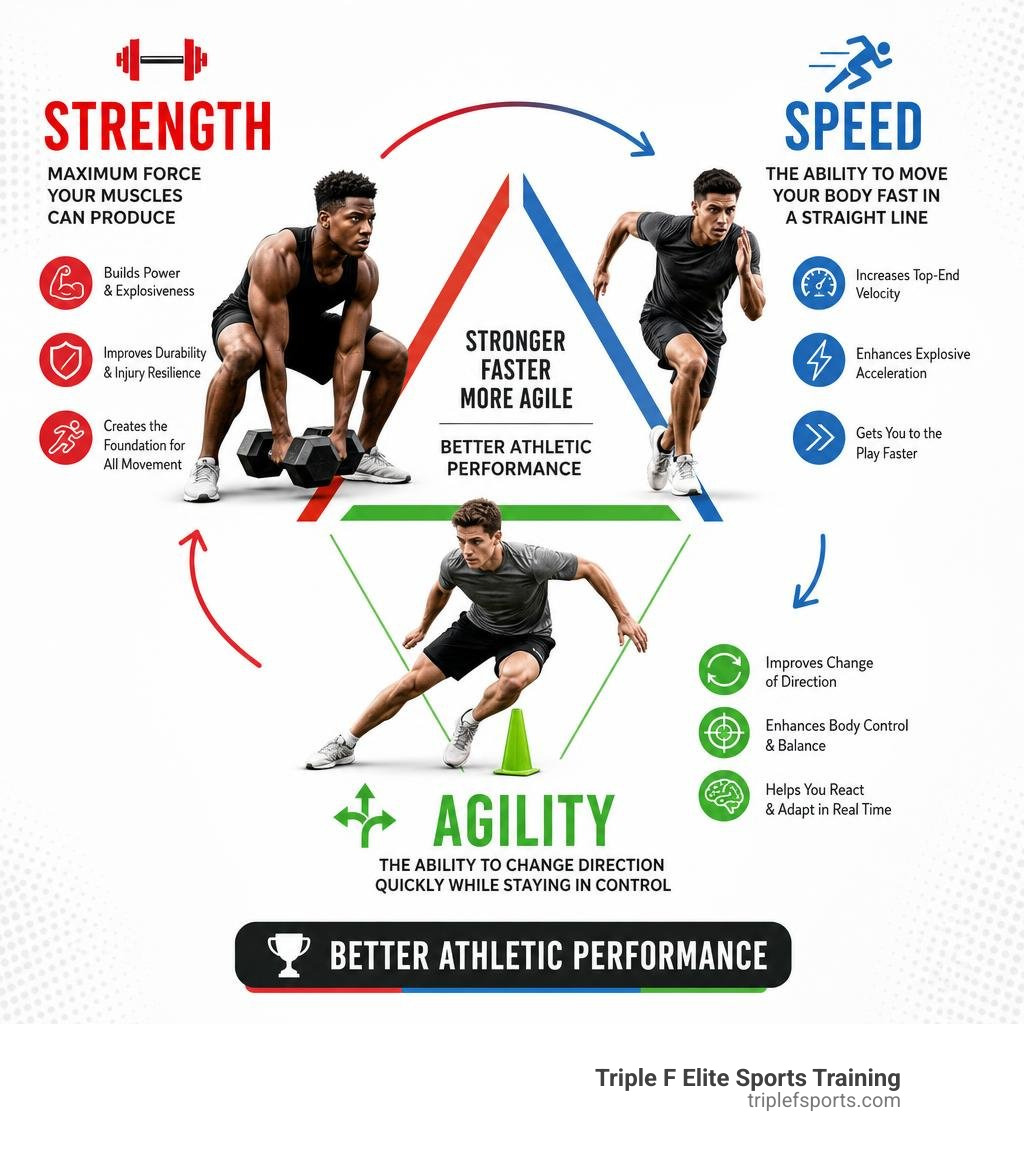
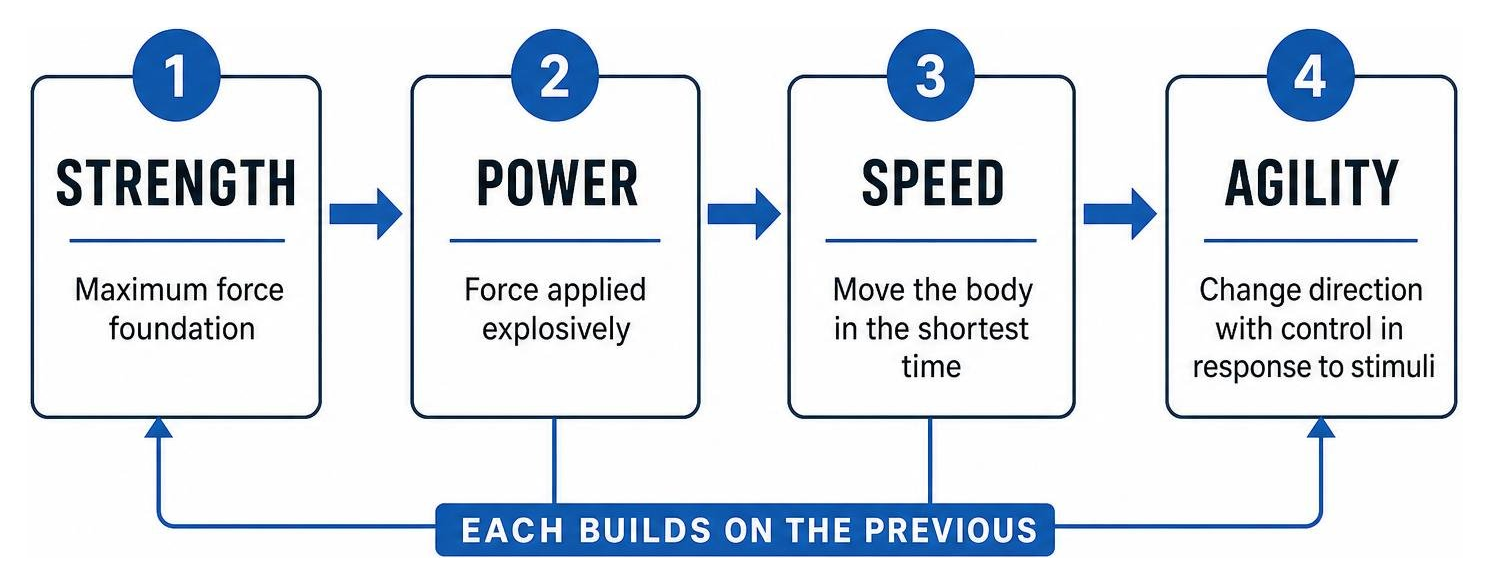
- Strength: This is the foundation of all movement. Physically, strength is the maximum force your muscles can exert against an external resistance (such as a barbell or the ground). Without a solid baseline of strength, you cannot build high levels of speed or power.
- Power: Power is strength’s explosive sibling. It is the rate of force development (RFD)—how quickly you can apply your strength. Mathematically, it is force multiplied by velocity. If you can squat 300 pounds slowly, you have strength. If you can clean 200 pounds in the blink of an eye, you have power.
- Speed: Speed is the ability to move the body or a body part through a distance in the shortest possible time. It consists of two main components: maximum velocity (top-end speed) and acceleration (how quickly you transition from a standstill to your top speed).
- Agility: True agility is often misunderstood. It is not just about executing a pre-planned cone drill as fast as possible. Agility is the ability to rapidly change direction, accelerate, or decelerate while maintaining balance and body control, typically in response to a stimulus (like an opponent’s movement or a ball’s bounce).
- Endurance: This is your body’s capacity to sustain a given work rate over time without succumbing to fatigue. It relies heavily on your aerobic and anaerobic energy systems to keep your muscles supplied with oxygen and energy during prolonged activity.
How Core Physical Attributes Interconnect
None of these attributes exist in a vacuum. During a dynamic game, your body relies on all of them simultaneously, utilizing the stretch-shortening cycle (SSC)—a natural muscle-tendon function where an active muscle lengthening (eccentric phase) is immediately followed by an active shortening (concentric phase). This mechanism acts like a loaded rubber band, storing elastic energy to produce a more powerful movement.
For example, when a basketball player cuts to the basket, they must decelerate (using eccentric strength), absorb the force (dynamic balance), and instantly rebound into a sprint (using the stretch-shortening cycle, power, and speed).
To see how these qualities match up, consider this comparison table:
| Physical Attribute | Primary Athletic Function | Key Physiological Driver | Real-World Sporting Example |
|---|---|---|---|
| Strength | Absorbing force and stabilizing joints | Muscle cross-sectional area & motor unit recruitment | Holding off a defender in soccer |
| Power | Launching the body or an object explosively | Rate of Force Development (RFD) & fast-twitch fibers | Exploding upward for a rebound |
| Speed | Covering linear distance rapidly | Step frequency and ground reaction force | Sprinting down the sideline on a breakaway |
| Agility | Making sharp, controlled directional changes | Neuromuscular control & cognitive processing | Cutting to evade a tackle |
| Endurance | Maintaining high-intensity output over time | Aerobic capacity & metabolic efficiency | Running at peak performance in the 4th quarter |
The Science of Strength and Agility: Neuromuscular Adaptations and Fast-Twitch Fibers

Building a body that is both powerful and quick is not just about growing larger muscles; it is about retraining your brain and nervous system. Your central nervous system (CNS) acts as the command center, deciding how many muscle fibers to recruit, how fast they should fire, and how smoothly they coordinate to produce movement.
Fast-Twitch Muscle Fiber Recruitment and Aging
Our muscles are made up of different types of fibers. Type I (slow-twitch) fibers are built for endurance and slow, sustained movements. Type II (fast-twitch) fibers are the powerhouses responsible for rapid, explosive movements like sprinting, jumping, and cutting.
As we age, a natural process called sarcopenia begins to take its toll. Starting around age 40, we lose 1% to 2% of our fast-twitch muscle fibers each year. This loss is why older adults often struggle with balance and are more prone to falls—their bodies simply cannot recruit stabilizing muscles quickly enough to catch themselves after a slip.
Fortunately, explosive power training and agility drills act as a shield against this decline. By forcing the central nervous system to recruit Type II fibers, we preserve our coordination, balance, and quick-twitch capabilities.
Furthermore, sports science research highlights a direct link between lower-body strength and quickness. For example, a study on the correlation between knee muscle strength and agility demonstrated a strong positive correlation (r = 0.699) between slow knee flexor (hamstring) peak torque and multi-directional agility performance.
Your hamstrings act as the “brakes” of your lower body; if your hamstrings are weak, your body will artificially limit your acceleration to prevent you from injuring yourself when you try to stop or cut.
What the Science Says About SAQ Training Protocols
Speed, Agility, and Quickness (SAQ) training is the gold standard for developing athletic movement. But how do we structure these sessions for the best results?
According to a comprehensive meta-analysis on SAQ training analyzing multiple clinical trials, structured SAQ training significantly improves multiple dimensions of athletic performance. The data reveals the following effect sizes (ES) for SAQ training:
- Lower limb power: Moderate-to-large improvement (ES = 0.96)
- 5-meter sprint performance: Moderate improvement (ES = 0.63)
- 20-meter sprint performance: Small-to-moderate improvement (ES = 0.49)
- 30-meter sprint performance: Small-to-moderate improvement (ES = 0.55)
- Change-of-direction (COD) speed: Small-to-moderate improvement (ES = 0.39)
- Reaction time: Moderate improvement (ES = 0.52)
- Flexibility: Small-to-moderate improvement (ES = 0.57)
Crucially, the researchers discovered that session duration matters. Training sessions lasting 60 minutes or less yielded significantly better improvements in change-of-direction performance (ES = 0.58) compared to sessions exceeding 60 minutes (ES = 0.24).
This is because agility is highly dependent on the central nervous system. Once neuromuscular fatigue sets in, movement quality degrades, and the training stimulus loses its effectiveness. Keep your speed and agility sessions short, intense, and highly focused.
Designing the Ultimate Performance Program
Knowing the science is one thing; organizing it into a safe, progressive training program is another. A well-designed routine must account for developmental differences across age groups and ensure that general physical qualities transfer directly to on-field success.
Designing Age-Appropriate Strength and Agility Programs
We cannot train a 10-year-old the same way we train a 22-year-old collegiate athlete. In youth athletic development, timing is everything, and programs must be tailored to an athlete’s physical maturity.
Pre-Adolescents (Ages 5-12)
At this stage, the nervous system is highly adaptable, but the skeletal system is still developing. Before puberty, athletes should focus on establishing a broad foundation of coordination, dynamic balance, and basic motor skills rather than heavy weightlifting.
We utilize a structured progression: youth should first master static and dynamic balance before moving on to complex agility drills and high-intensity plyometrics.
As highlighted in a study comparing training methods, combining agility and plyometrics provides similar performance benefits as combining balance and plyometrics in young athletes. This means that teaching a young athlete how to land softly and balance on one leg is just as valuable for their speed as running them through endless ladder drills.
To learn more about how to guide young athletes safely, check out our guide on youth athletic development.
Adolescents & Adults (Ages 13+)
Once athletes pass their peak height velocity (their adolescent growth spurt), their hormonal profiles allow for significant gains in muscle mass and strength. This is the time to introduce progressive overload with resistance training (squats, deadlifts, presses) while continuing to refine high-velocity movement mechanics.
Integrating Strength and Agility with Sport-Specific Training
The ultimate goal of any conditioning program is transfer: we want the strength built in the weight room and the quickness built on the turf to show up during game time.
To achieve this, training must match the movement profiles of the sport. A soccer player needs to build multi-directional capacity and the ability to sustain short, repeated sprints over 90 minutes. A volleyball player needs exceptional vertical power and rapid lateral shuffling.
By blending general physical conditioning with sport-specific movement mechanics, we give athletes a distinct competitive edge while reinforcing safe movement patterns that reduce injury risk.
Practical Drills and Explosive Movements for Power and Quickness
Let’s translate theory into action. To build a body that is both powerful and quick, your weekly routine should feature a mix of structured agility drills, explosive power movements, and reactive cognitive tasks.
Top Agility Exercises for Rapid Change of Direction
Agility drills are designed to teach your body how to decelerate, stabilize, and re-accelerate in a new direction efficiently. Here are three foundational drills we use:
- Agility Ladder Drills (e.g., Two-In-Two-Out, Ickey Shuffle): These drills are fantastic for developing foot speed, rhythm, and coordination. They teach your nervous system to make rapid, precise adjustments to foot placement. To master these, check out our top agility ladder drills.
- The T-Drill: Set up four cones in a “T” shape, with each cone placed 5 yards apart. Start at the base of the T, sprint forward to the center cone, side-shuffle to the left cone, side-shuffle all the way to the right cone, side-shuffle back to the center, and backpedal to the start. Repeat this 6 to 8 times, focusing on keeping your hips low during transitions.
- Lateral Plyometric Jumps (Skater Jumps): Stand on one foot, bend your knee slightly, and leap explosively to the side, landing softly on the opposite foot. Hold the landing for a second to build dynamic balance before leaping back. This builds the lateral power needed for explosive cutting.
For more tips on refining your movement, read our complete agility guide.
Incorporating Explosive Power Movements Safely
Explosive movements bridge the gap between heavy strength and rapid agility. However, they must be performed with pristine form to protect your joints.
- Squat Jumps: Lower into a quarter-squat, then explode upward as high as possible. The secret to safety here is the landing: always land softly on the balls of your feet, immediately absorbing the impact by sinking back into a controlled quarter-squat.
- Kettlebell Swings: This movement trains explosive hip extension—the exact motion that drives sprint acceleration. Focus on hinging at your hips (pushing your glutes backward) rather than squatting, and snap your hips forward explosively to swing the weight.
By keeping repetitions low (3 to 5 reps per set) and focusing on maximum speed and quality rather than muscular fatigue, you can build explosive power safely.
Cognitive Processing and Reactive Agility
In a real game, you never know where the ball or your opponent is going next. That is why pre-planned drills are only half the battle. To build true agility, we must train the brain alongside the body.
Recent research published in Frontiers | Reactive agility—evidence based suggestions for improvement shows that reactive agility is heavily dependent on cognitive inhibitory control (the brain’s ability to process a visual cue, ignore distractions, and change a pre-planned movement on a dime) and eccentric hamstring strength.
The study identified that athletes who met at least two of the following benchmarks had a 2.04 times higher likelihood of above-average reactive agility:
- Eccentric hamstring strength of $\ge$ 2.5 Nm/kg
- Stroop (cognitive interference) test score of $\le$ 0.415 seconds
- Drop jump ground contact time of $\le$ 0.174 seconds (indicating a highly efficient stretch-shortening cycle)
To train this, replace simple cone drills with partner-chase drills, whistle-reactive cuts, or visual-pointing cues. This forces your brain to scan, decide, and move simultaneously, ensuring you don’t get your ankles broken on the field.
Year-Round Training for Youth Female Athletes and Injury Prevention
For youth female athletes, strength and agility training is not just about performance—it is a critical shield against career-threatening injuries.
The Critical Role of Year-Round Conditioning
A common mistake among youth athletes is treating strength and conditioning as an “off-season only” activity. When the competitive season starts, many athletes stop lifting entirely to focus on games.
Unfortunately, muscles begin to atrophy and lose strength after just 4 weeks without a training stimulus. By the middle of the season—when games get toughest—athletes are at their weakest and most vulnerable to injury.
Furthermore, a study in the Journal of Strength and Conditioning Research comparing resisted agility and repeated sprint training vs. traditional strength training in elite female soccer players found that in-season training must be carefully balanced.
Because active competition creates a highly stressful, catabolic environment, adding heavy, unaccustomed lifting during the season can cause neuromuscular fatigue and actually hurt agility.
Instead, the off-season should be used to build a massive foundation of strength, while the in-season should focus on short, high-quality maintenance sessions (1 to 2 times per week) to preserve joint stability and muscle mass.
ACL Injury Prevention and Return-to-Sport Recovery
Female athletes are statistically at a much higher risk for ACL tears due to anatomical and biomechanical factors, such as landing with more upright knees and possessing a wider Q-angle (pelvis-to-knee ratio).
To prevent these injuries, we must focus on:
- Deceleration Mechanics: Teaching athletes to bend their knees, lean their shoulders forward, and absorb forces through their glutes and hamstrings rather than their knee joints when stopping.
- Hamstring-to-Quadriceps (H:Q) Ratio: Many female athletes are “quad-dominant,” meaning their quadriceps pull much harder than their hamstrings, placing immense stress on the anterior cruciate ligament. Strengthening the hamstrings through heavy loading (such as Romanian deadlifts and Nordic curls) is essential.
Traditional physical therapy is excellent for restoring range of motion after an injury, but it often fails to prepare an athlete for the chaotic, high-speed demands of competitive play (where speeds regularly exceed 14 MPH).
Bridging this gap requires transition training that combines heavy resistance loading with cognitive agility work. To start building this foundation at home, grab our ultimate athletic training program PDF.
Frequently Asked Questions about Strength and Agility
How does agility training reduce the risk of lower extremity injuries?
Agility training reduces injury risk by dramatically improving neuromuscular control and proprioception (your body’s internal sense of where it is in space).
By teaching your muscles to react instantly to sudden shifts in balance, you protect your joints from awkward landings and hyperextensions.
For example, a study on TRX-based functional training in youth players showed that just 8 weeks of suspension training significantly improved dynamic balance in all directions (as measured by the Y-Balance Test), which directly correlates with a lower risk of ankle sprains and knee injuries.
What is the difference between strength and power in athletic movement?
Strength is the absolute maximum force your muscles can generate, regardless of time (e.g., a slow, grinding 400-pound deadlift). Power is the ability to apply that force quickly (e.g., a 200-pound power clean or a vertical jump).
In sports, you rarely have time to slowly build up force; you need to apply it instantly. Therefore, while strength is the foundation, you must train power to translate that strength into explosive athletic movement.
To learn more about optimizing this balance, see our guide on maximizing athletic potential.
How long should an agility training session last for optimal results?
Agility training should be kept under 60 minutes, with the high-intensity portion lasting around 20 to 30 minutes.
Because agility is heavily dependent on the central nervous system, training while fatigued degrades your movement mechanics and increases your risk of injury.
Keep your sessions short, prioritize explosive quality over exhausting quantity, and allow 24 to 48 hours of recovery between intense sessions. For a complete breakdown of how to structure your training week, check out our ultimate guide to athlete performance training.
Conclusion
Building a body that is both powerful and quick requires a deliberate, science-backed approach. By combining progressive strength training with explosive power work, structured SAQ drills, and reactive cognitive training, you can unlock your full athletic potential while building a body that is resilient to injuries.
At Triple F Elite Sports Training in Knoxville, TN, we specialize in helping athletes of all ages and skill levels achieve this balance. Our professional, Christ-centered athletic development programs combine state-of-the-art sports performance training with expert physical therapy to build stronger, faster, and smarter competitors.
Ready to take your game to the next level? Schedule a Free Trial with us today and experience the Triple F difference firsthand!